28 August 2026 · 8 min read
India's Trading Boom: Why Global Brokers Are Watching South Asia
Mumbai hosts Money Expo India 2026 this week while SEBI data shows record currency-derivatives activity — here is what global brokers actually see in South Asia, and what the rules still forbid.
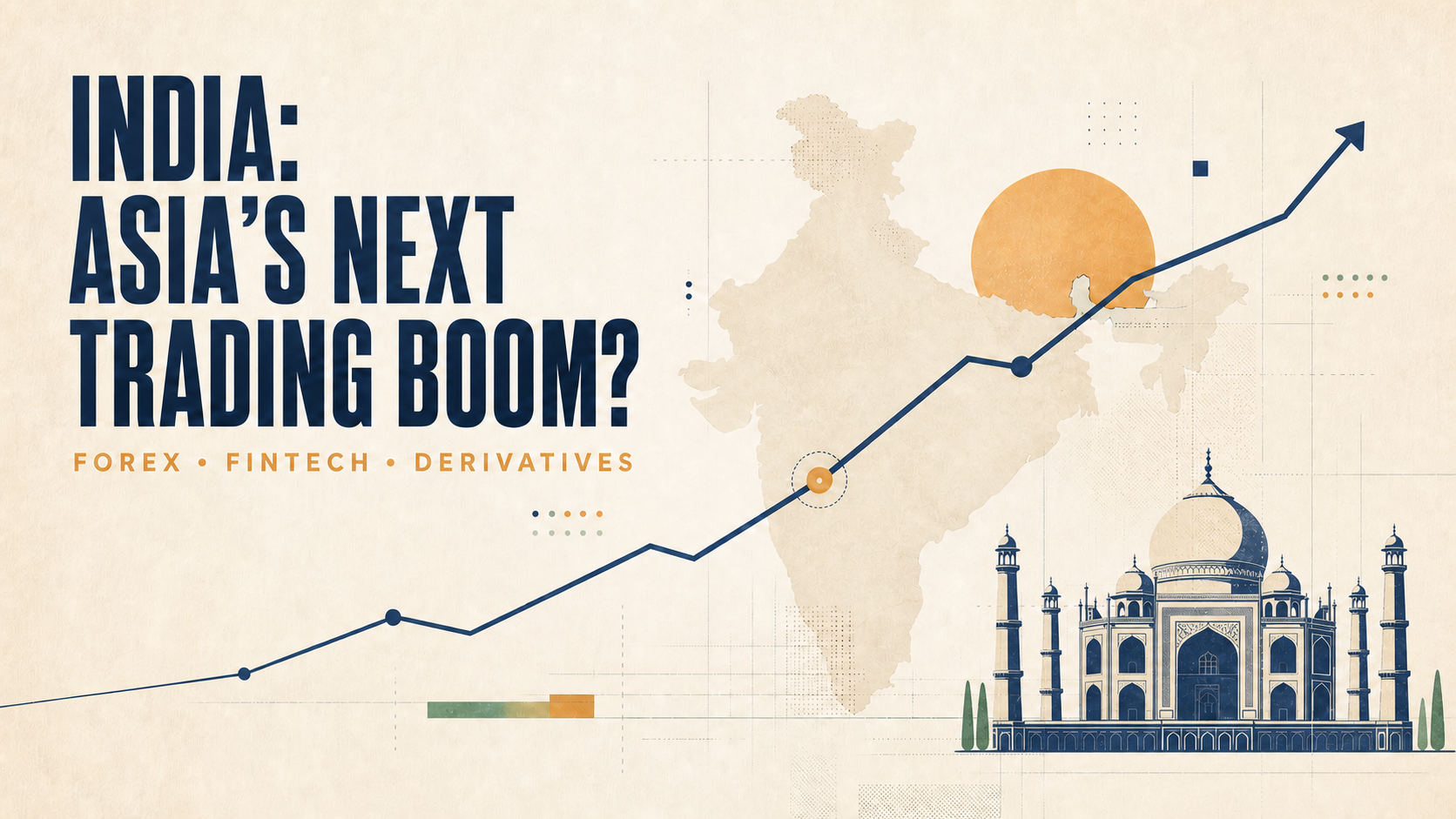
South Asia has moved to the centre of the global broker conversation, and the calendar explains part of the reason. Money Expo India 2026 is scheduled for 29–30 August 2026 at the Jio World Convention Centre in Mumbai, bringing together trading firms, brokers, fintech providers, investors, affiliates and introducing brokers in one place.
The interest is not only promotional. Regulatory data points to a market with genuine depth in the segments brokers care about most.
What the official numbers show
SEBI listed 2,699 registered stock brokers in the Currency Derivative Segment as of 27 August 2026 — a large, established intermediary base rather than a young or thin market.
SEBI's April 2026 bulletin reported that currency-derivatives notional turnover rose 75% month on month to a fiscal-year high of about ₹1.3 lakh crore in March 2026. That combination of intermediary count and turnover momentum is what draws attention from firms operating across Asia.
What is driving the momentum
The first driver is demographic: a digitally active, younger investor base that opens and manages accounts entirely on mobile and expects fast onboarding, transparent pricing and responsive support.
The second is infrastructure. India has developed a dense ecosystem of brokers, fintech providers, liquidity partners and CRM vendors — the operational layer that lets a trading business scale rather than merely launch.
The third is geography. India sits at a strategic link between South Asia, the Middle East, Singapore and Hong Kong, which makes it a natural node for firms building regional coverage rather than single-country operations.
Why local partners and IBs matter
Regional expansion in India is rarely a translation exercise. Local partners and introducing brokers carry the practical knowledge of regulatory boundaries, language expectations, payment behaviour and the trust signals that clients actually respond to.
They also shape responsible marketing. Claims, risk warnings and promotional framing that are acceptable in one market can be unacceptable in another, and a local partner is usually the first line of defence against that risk.
Market interest is not the same as market access
Strong data and a busy expo floor do not mean foreign OTC forex services may freely serve Indian residents. Interest in the market and permission to solicit it are separate questions, and the second one is decided by regulation, not demand.
Money Expo India's own terms state that some international financial services shown at the event may be intended only for NRIs and may not apply to Indian residents. Any firm reading South Asia as an opportunity should treat that distinction as the starting point of its planning, not a footnote.
Official sources
Compliance and risk disclaimer
This article is published by TradeRadar.Asia for informational purposes only. It is not investment advice, a solicitation, or an offer to buy or sell any financial product. Leveraged products such as CFDs and currency derivatives carry a high level of risk and can result in the loss of your entire capital. Availability of any service depends on the laws of your jurisdiction; readers are responsible for ensuring their own compliance.